

October 14, 2026
India’s GST Export Reforms 2026: Why Services to Overseas Branches May Finally Qualify as Exports
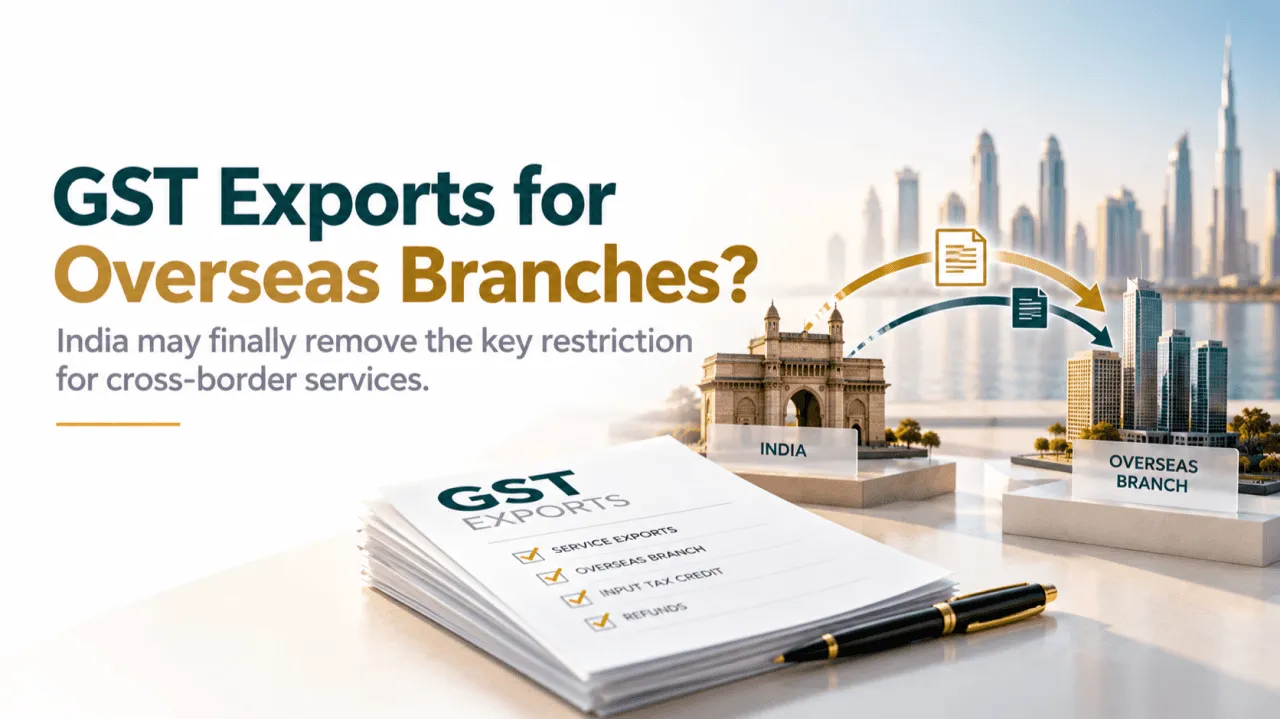
An Indian company builds software in Bengaluru. It gives engineering support from Pune. It serves clients abroad through branches in Dubai, London or Singapore.
As a business, it sells services across borders.
Yet under India's current GST rules, a supply from the Indian head office to its own overseas branch may not count as an export. That holds even when the branch uses the work for its own overseas operations.
The problem is not mainly that the work is used in India. It is that the supplier and the recipient are parts of one legal person.
That one test has left a gap between how a deal looks and how GST treats it.
On 8 October 2026, India's 57th GST Council backed the removal of this bar. It also backed other reforms meant to help cross-border services.
If they take effect, Indian firms may gain more room to run overseas branches, claim back GST credit and manage work for clients abroad.
But one point matters. These are GST Council proposals, not yet amendments to the Act. Firms must keep to the current law until the changes take effect.
The wider point is this:
A service can cross a border and earn money abroad yet not count as an export under tax law.
Why an Overseas Branch Creates a GST Problem
Section 2(6) of the Integrated Goods and Services Tax Act, 2017 sets five tests for a service to count as an export.
The supplier must be in India. The recipient must be outside India. The place of supply must also be outside India. Payment must come in convertible foreign exchange, or in rupees where the RBI allows it.
The fifth test is the one that causes trouble.
Section 2(6)(v) sets a bar: the supplier and the recipient must not be establishments of a distinct person under Explanation 1 to section 8.
That test bites because GST law treats an Indian office and its foreign branch as two separate establishments, even though in law they are one company.
In Circular No. 161/17/2021-GST, dated 20 September 2021, CBIC said this in terms. Services from an Indian company to its own foreign branch do not count as exports, because of this bar.
Take an Indian engineering firm with a branch in Singapore.
The Indian office does the design work, the technical papers and the project support for contracts run through Singapore.
The branch uses that work for its own overseas operations.
But under the present export test, the Indian office cannot treat the supply to its own Singapore branch as an export just because the work helps the overseas side.
That leaves open problems on tax treatment, on input tax credit that piles up, and on export refunds.
What Exactly Has the GST Council Proposed?
The main proposal is to drop section 2(6)(v) of the IGST Act.
If that happens, a supply between two arms of the same person would no longer fail the export test just because of that link.
The Council said the change is meant to help refunds for Indian service firms that supply to or through their foreign offices and branches.
That can matter for Indian consulting, IT, engineering, architecture, finance-support and other service firms that work abroad through branches, not through separate subsidiaries.
But the proposal does not mean every internal charge to an overseas office becomes an export.
The deal must still be a supply under GST law. The place of the recipient, the place of supply, the payment terms, the value and the records must all be checked.
How internal branch charges are treated, including cases with no normal third-party payment, will need close attention when the amendment and the rules that back it are issued.
An Overseas Branch Is Not the Same as a Foreign Subsidiary
This is where firms should be careful.
A Dubai branch of an Indian company and a UAE subsidiary that stands on its own are very different set-ups in law.
The branch is usually a part of the Indian legal entity.
The subsidiary is a separate legal person.
CBIC's 2021 circular already said that an Indian company and a separately set up foreign group company are not merely establishments of the same person for section 2(6)(v).
So services from an Indian company to a foreign subsidiary could already count as exports, if the other tests were met.
The proposed reform therefore matters most for branch set-ups.
For founders weighing a branch or a subsidiary to enter the UAE, UK or Singapore, it may remove one GST drawback of the branch route.
It does not, though, remove the wider legal, regulatory, direct-tax and liability gaps between the two.
Another Important Reform: Services Performed on Goods in India
The GST Council has backed a second change that deserves attention.
Today, section 13(3)(a) of the IGST Act places the supply of services on goods handed to the provider at the place where the work is done, with a few exceptions.
That can hurt Indian firms that test, inspect, repair, certify or engineer goods that sit in India.
Even where the client is overseas, the place of supply may be India.
The Council has backed dropping section 13(3)(a), so the default rule in section 13(2), based on the client's location, applies to these services.
Take a German firm that hires an Indian lab to test equipment kept in India.
Under the present rule, the place of supply may be India, unless an exception in the Act applies.
If the change goes through, the foreign client's location could decide the place of supply under the default rule, so export treatment may be open if the other tests are met.
That could matter a lot for Indian engineering, testing, research and technical service firms.
The proposal covers only this rule for goods-related services. It does not remove other special place-of-supply rules, such as those for land and buildings, intermediary services or events.
Why the Change Matters Beyond GST Rates
For exporters, zero rating affects working capital.
Under section 16 of the IGST Act, exports that qualify are zero-rated supplies.
Where the rules allow, exporters can usually make zero-rated supplies under a Letter of Undertaking without paying IGST, and claim refunds of the input tax credit that has built up. Refunds under other routes depend on the law and the notifications in force.
Take an Indian tech firm that pays a lot of GST on software subscriptions, professional fees, offices and other running costs.
If its work for overseas clients fails the export test, the firm may not get zero-rated export refunds on that work.
The result can be credit that piles up, more work to comply, or a higher real cost of delivery.
Where the reform widens the pool of zero-rated supplies, it could improve cash flow and the ability to compete.
The gain is not just less GST paid. It is possibly getting back tax that is built into the cost of running an overseas service business.
GST and FEMA Must Work Together
A second issue comes from the payment test.
The GST Council has backed a circular to spell out how export payment in foreign currency, or in rupees where the rules allow, should be received.
This matters because GST treatment of export receipts must fit RBI rules.
The timing matters too.
The Foreign Exchange Management (Export and Import of Goods and Services) Regulations, 2026 took effect on 1 October 2026. They set out a new framework for cross-border trade in goods and services, including reporting and authorised dealer steps.
In a normal deal with a foreign client, the firm can point to the contract, the invoice, the payment due and the money received.
A branch set-up may be less clear.
The Indian office and the branch may keep internal cost charges, inter-office accounts or netting arrangements, rather than the normal dues between two legally separate companies.
Those need one joint GST and FEMA review.
Dropping the distinct-establishment bar will not, by itself, show that every internal book entry meets the rest of the export payment test.
How Does This Compare With International VAT Principles?
India's proposals also matter from a wider global indirect-tax angle.
The OECD's International VAT/GST Guidelines back the destination rule: traded services should usually be taxed where they are used.
For normal business-to-business services, the client's location is the practical stand-in for the taxing state. The OECD rules also look at firms that work through more than one establishment.
The UK VAT system, for one, usually sets the place of supply of B2B services by where the business client belongs, with exceptions and rules for establishments.
These rules help explain the shape of India's proposals.
But OECD VAT guidance is not domestic law, and it does not force each state to treat internal branch deals the same way.
A service treated as an export from India may still need a VAT or GST review in the UAE, UK, Singapore or another state where the client sits.
In the same way, the branch's corporate tax or permanent establishment position is a separate issue. Any split of business profits, or transfer pricing review, must follow the direct-tax rules that apply.
What I Would Recommend to Businesses Now
My own view is to review the current cross-border service flows before changing the legal set-up.
Start by finding out who receives and uses each service, whether the overseas arm is a branch or a separate company, where the place of supply falls, and how the payment is recorded and settled.
The contracts, the service notes, the branch accounts, the client data, the invoices that back them and the foreign-exchange records should all tell the same story.
For firms with GST credit that has built up, or with export refund claims in dispute, the proposals also justify a review of the positions taken.
But do not assume old claims will get relief for past years, unless the final amendments say so in terms.
The design work can start now. Use the new GST treatment only when it is law.
Closing Perspective
India has built a large service industry for overseas clients, and the ways it delivers that work have grown more varied.
Some firms serve foreign clients direct. Others use subsidiaries, branches, liaison offices or regional delivery hubs.
GST treatment should reflect those differences without putting needless blocks in the way of real cross-border trade.
The 57th GST Council's proposals are a big step in that direction.
For founders and CFOs, the key rule is this:
A global operating model should not lose export benefits only because the firm works through its own overseas arm.
If they come in as proposed, the amendments could ease a real friction point in India's cross-border service rules.
The next test will be to make the amended export definition, the payment rules, the FEMA rules and the refund steps work together in practice.
That is where the real gain will be decided.
Research basis
This article rests on the official proposals of the 57th GST Council meeting of 8 October 2026; sections 2(6), 8, 13 and 16 of the IGST Act, 2017; CBIC Circular No. 161/17/2021-GST; the RBI's Foreign Exchange Management (Export and Import of Goods and Services) Regulations, 2026; the OECD International VAT/GST Guidelines; and HMRC's VAT Notice 741A.
Research cut-off: 11 October 2026. The proposed amendments to the IGST Act and the export-payment clarification are discussed as proposals, not as law in force.
Financial Insights
Expert tips and emerging industry trends