

October 14, 2026
India’s GST Export Reforms 2026: Why Services to Overseas Branches May Finally Qualify as Exports
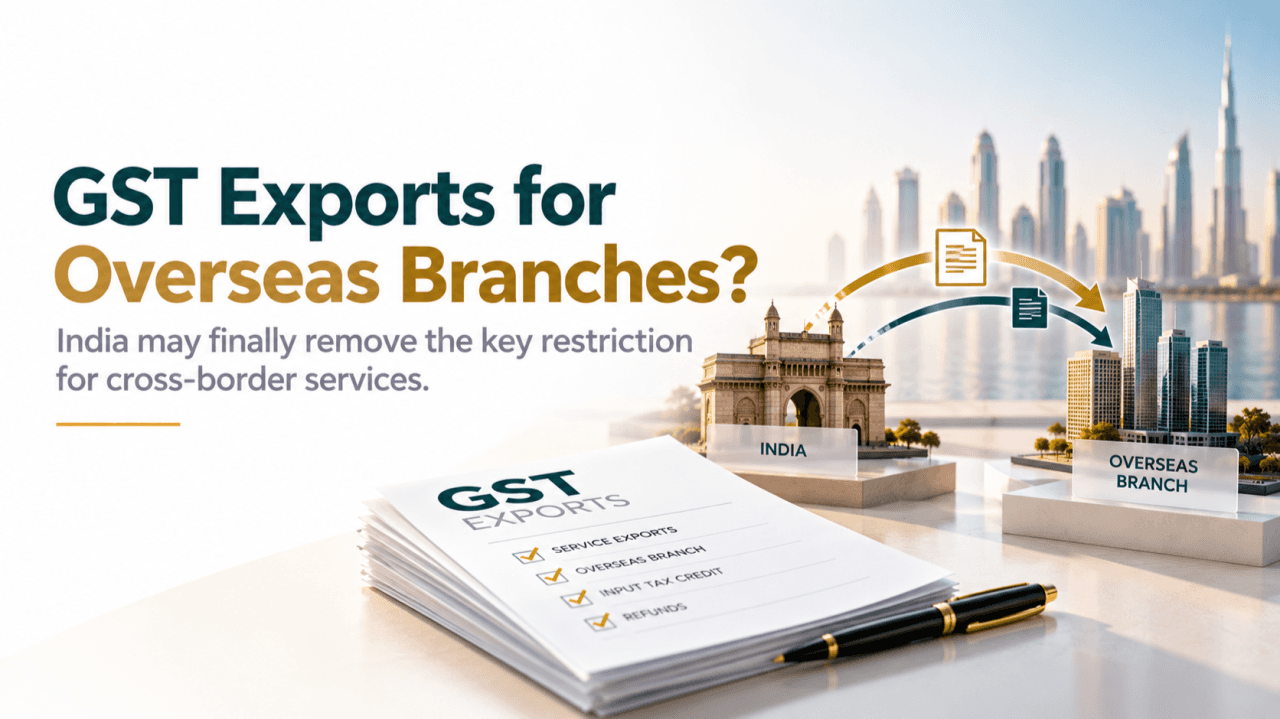
An Indian company develops software in Bengaluru, provides engineering support from Pune and serves international customers through branches in Dubai, London or Singapore.
Commercially, it is an international services business.
Yet under India's existing GST framework, services supplied by the Indian establishment to its own overseas branch can fail to qualify as exports, even where the overseas branch uses those services for its foreign operations.
The difficulty arises not necessarily because the services are consumed in India, but because the supplier and recipient are establishments of the same legal person.
That distinction has created an unusual disconnect between commercial reality and GST treatment.
On 8 October 2026, India's 57th GST Council recommended removing this restriction, alongside other reforms intended to facilitate cross-border services.
The proposals could materially change how Indian businesses organise overseas branches, recover GST credits and manage international service delivery.
But there is an important qualification: these are GST Council recommendations, not yet operative statutory amendments. Businesses must continue applying the existing law until the relevant changes take effect.
The wider lesson is significant:
A service can cross an international border commercially without qualifying as an export under the tax law.
Why an Overseas Branch Creates a GST Problem
Section 2(6) of the Integrated Goods and Services Tax Act, 2017 presently prescribes five conditions for a service to qualify as an export.
The supplier must be located in India, the recipient outside India, and the place of supply outside India. Payment must be received in convertible foreign exchange or Indian rupees wherever permitted by the RBI.
The fifth condition creates the difficulty.
Under section 2(6)(v), the supplier and recipient cannot merely be establishments of a distinct person within the meaning of Explanation 1 to section 8.
That distinction matters because GST law treats an Indian establishment and its foreign branch as distinct establishments, even though legally they belong to the same company.
In Circular No. 161/17/2021-GST, dated 20 September 2021, CBIC expressly clarified that services supplied by an Indian company to its own foreign branch do not qualify as exports because of this restriction.
Consider an Indian engineering company with a Singapore branch.
The Indian office undertakes engineering design, technical documentation and project support for contracts executed through Singapore.
The overseas branch uses that work for its international operations.
However, under the existing GST definition, the Indian establishment cannot simply treat the supply to its own Singapore branch as an export merely because the work benefits the foreign operation.
This creates potential difficulties concerning tax treatment, input-tax-credit accumulation and export-related refunds.
What Exactly Has the GST Council Proposed?
The most important recommendation is the omission of section 2(6)(v) of the IGST Act.
If implemented, a supply between establishments of the same person would no longer be disqualified from export status solely because of that relationship.
The Council specifically explained that the change is intended to facilitate refunds for Indian service providers supplying services to or through their foreign offices and branches.
This is potentially important for Indian consulting, IT, engineering, architecture, financial-support and other service businesses that operate internationally through branches rather than separately incorporated subsidiaries.
But the recommendation does not mean that every internal allocation to an overseas office automatically becomes an export.
The arrangement must still constitute a supply under the applicable GST provisions. The recipient's location, place of supply, payment conditions, valuation and supporting documentation must also be examined.
The precise treatment of internal branch allocations, including situations where there is no conventional third-party payment, will require particular attention when the amendment and implementing clarifications are issued.
An Overseas Branch Is Not the Same as a Foreign Subsidiary
This is where businesses should be especially careful.
An Indian company's Dubai branch and an independently incorporated UAE subsidiary are fundamentally different legal structures.
The branch is ordinarily an establishment of the Indian legal entity.
The subsidiary is a separate legal person.
CBIC's 2021 circular already clarified that an Indian company and a separately incorporated foreign group company are not merely establishments of the same person for the purpose of section 2(6)(v).
Consequently, services supplied by an Indian company to a foreign subsidiary could already qualify as exports, provided the other statutory conditions were satisfied.
The proposed reform is therefore particularly relevant to branch structures.
For founders evaluating whether to enter the UAE, UK or Singapore through a branch or subsidiary, it potentially removes one GST disadvantage associated with operating through a foreign branch.
It does not, however, eliminate the wider legal, regulatory, direct-tax and liability differences between the two structures.
Another Important Reform: Services Performed on Goods in India
The GST Council has recommended a second change that deserves considerable attention.
Currently, section 13(3)(a) of the IGST Act generally places the supply of services relating to goods physically made available to the service provider at the location where the services are performed, subject to specific exceptions.
This can create difficulties for Indian businesses providing testing, inspection, repair, certification and engineering services involving goods situated in India.
Even where the service recipient is overseas, the place of supply may be India.
The Council has recommended omitting section 13(3)(a), allowing the default rule under section 13(2), based on the recipient's location, to apply to these services.
Consider a German industrial company engaging an Indian laboratory to test equipment physically located in India.
Under the existing performance-based rule, the service may have an Indian place of supply, unless a statutory exception applies.
Following the proposed amendment, the foreign customer's location could become decisive under the default rule, potentially allowing export treatment if the remaining conditions are met.
This could be commercially significant for Indian engineering, testing, research and technical-service providers.
Importantly, the proposal concerns the specified goods-related place-of-supply rule. It does not abolish other special place-of-supply provisions concerning matters such as immovable property, intermediary services or events.
Why the Change Matters Beyond GST Rates
For exporters, zero rating has a direct working-capital consequence.
Under section 16 of the IGST Act, qualifying exports are zero-rated supplies.
Subject to the applicable requirements, exporters can generally make zero-rated supplies under a Letter of Undertaking without payment of IGST and claim refunds of eligible accumulated input tax credit. Other permitted refund mechanisms depend on the prevailing statutory conditions and notifications.
Imagine an Indian technology business incurring substantial GST on software subscriptions, professional services, infrastructure and other operating expenditure.
If its international service transactions fail the export definition, the company may not have access to the corresponding zero-rated export refund treatment.
The result can be accumulated credit, additional compliance effort or a higher effective cost of delivering the service.
Where the proposed reform expands eligible zero-rated supplies, it could therefore improve cash flow and competitiveness.
The benefit is not simply paying less GST. It is potentially recovering tax embedded in the cost of building an international service business.
GST and FEMA Must Work Together
A second issue arises from the payment condition.
The GST Council has recommended issuing a circular clarifying receipt of export consideration in foreign currency or Indian rupees wherever permitted.
This matters because the treatment of export receipts under GST must operate consistently with applicable RBI regulations.
The timing is particularly relevant.
The Foreign Exchange Management (Export and Import of Goods and Services) Regulations, 2026, effective from 1 October 2026, have introduced an updated framework covering cross-border goods and services transactions, including reporting and authorised-dealer processes.
For an ordinary foreign customer transaction, the company can generally identify the contract, invoice, payment obligation and actual remittance.
An overseas branch arrangement may be less straightforward.
The Indian head office and foreign branch may maintain internal cost allocations, inter-office accounts or settlement mechanisms rather than conventional receivables between two legally separate companies.
Those arrangements require a coordinated GST and FEMA analysis.
Removing the distinct-establishment restriction will not, by itself, establish that every internal accounting entry satisfies the remaining export-payment condition.
How Does This Compare With International VAT Principles?
India's proposed changes are also relevant from a wider global indirect-tax perspective.
The OECD's International VAT/GST Guidelines support the destination principle, under which internationally traded services should generally be taxed in the jurisdiction of consumption.
For ordinary business-to-business services, the customer's location is generally used as the practical proxy for determining the taxing jurisdiction. The OECD framework also addresses businesses operating through multiple establishments.
The UK's VAT system, for example, generally determines the place of supply of B2B services by reference to where the business customer belongs, subject to exceptions and establishment-specific rules.
These principles help explain the direction of India's proposals.
However, OECD VAT guidance is not domestic legislation, and it does not require every jurisdiction to treat internal branch transactions identically.
A service treated as an export from India may still require a separate VAT or GST assessment in the UAE, UK, Singapore or another recipient jurisdiction.
Likewise, the branch's corporate-tax or permanent-establishment position is a separate issue. Any attribution of business profits or intercompany transfer pricing analysis must follow the applicable direct-tax rules.
What I Would Recommend to Businesses Now
My preference would be to review existing international service flows before changing the legal structure.
The starting point should be identifying exactly who receives and uses each service, whether the overseas presence is a branch or separate company, where the place of supply falls, and how the consideration is recorded and settled.
Contracts, service descriptions, branch accounts, customer information, supporting invoices and foreign-exchange records should tell a consistent story.
For businesses with accumulated GST credits or disputed export refund claims, the proposed reforms also justify reviewing the underlying positions.
However, existing claims should not be assumed to receive retrospective relief unless the final amendments expressly provide for it.
The operational design can begin now. The revised GST treatment should be adopted only when legally effective.
Closing Perspective
India has developed a substantial international services industry, but its overseas delivery structures have become increasingly diverse.
Some businesses serve foreign customers directly. Others use subsidiaries, branches, representative offices or regional delivery arrangements.
The GST treatment should reflect those differences without unnecessarily obstructing genuine international trade.
The 57th GST Council's proposals are an important step in that direction.
For founders and CFOs, the key principle is:
An international operating model should not lose export benefits merely because the business operates through its own overseas establishment.
If implemented as proposed, the amendments could reduce an important friction in India's cross-border services framework.
The next challenge will be ensuring that the amended export definition, payment rules, FEMA requirements and refund procedures work together in practice.
That is where the real commercial benefit will be determined.
Research basis
This article is based on the official recommendations of the 57th GST Council meeting dated 8 October 2026; sections 2(6), 8, 13 and 16 of the IGST Act, 2017; CBIC Circular No. 161/17/2021-GST; the RBI's Foreign Exchange Management (Export and Import of Goods and Services) Regulations, 2026; the OECD International VAT/GST Guidelines; and HMRC's VAT Notice 741A.
Research cut-off: 11 October 2026. The proposed amendments to the IGST Act and the recommended export-payment clarification are discussed as proposals, not operative law.
Financial Insights
Expert tips and emerging industry trends