

February 16, 2025
Introduction
In an increasingly globalized world, cross-border transactions and international trade have grown significantly. However, this brings a major challenge—double taxation. Double taxation happens when the same income is taxed twice, once in the country where it is earned and again in the country where the taxpayer resides.
To address this issue, India has entered into Double Taxation Avoidance Agreements (DTAAs) with various countries. The Indian Income Tax Act, 1961, contains two important sections to deal with this:
Section 90: Governs tax agreements between India and foreign governments.
Section 90A: Governs tax agreements between Indian and foreign specified associations.
However, with the Income Tax Bill, 2025, the government has proposed Section 159, which consolidates and refines these provisions. This article provides a detailed comparison of these sections to understand the changes, improvements, and implications for taxpayers.
Understanding Section 90 (Income Tax Act, 1961)
What is Section 90?
Section 90 of the Income Tax Act, 1961, allows the Central Government to enter into agreements with foreign countries or specified territories to:
Provide relief from double taxation, ensuring the same income is not taxed twice.
Prevent tax evasion and avoidance, ensuring fair taxation.
Exchange tax-related information to curb black money and tax evasion.
Facilitate tax recovery, ensuring tax liabilities are collected efficiently across borders.
Key Provisions of Section 90
The Central Government signs DTAAs with other nations to ensure businesses and individuals do not face double taxation.
The DTAA overrides domestic tax laws where applicable, meaning treaty benefits apply if they are more favourable.
Anti-treaty shopping measures are included to prevent tax abuse through shell companies or artificial arrangements.
The exchange of tax information helps tax authorities track financial transactions across countries.
Who Benefits from Section 90?
Indian residents earning foreign income (e.g., salary, dividends, interest, royalties).
Foreign residents earning Indian income (e.g., business income, capital gains).
Businesses operating in multiple countries that want to avoid double taxation.
Understanding Section 90A (Income Tax Act, 1961)
What is Section 90A?
While Section 90 deals with agreements between governments, Section 90A allows Indian and foreign "specified associations" (such as trade or industry associations) to enter into agreements for double taxation relief, with approval from the Central Government.
Key Provisions of Section 90A
Any specified association in India can enter into an agreement with a foreign specified association.
The agreement requires Central Government notification to be effective.
The purpose is double taxation relief, tax information exchange, and tax recovery, similar to Section 90.
Taxpayers to whom the agreement applies can choose the more beneficial option between the agreement and the ITA.
Who Benefits from Section 90A?
Trade and industry associations that deal with cross-border transactions.
Professional bodies and business groups that require taxation clarity in their dealings with foreign counterparts.
Introduction of Section 159 (Income Tax Bill, 2025)
Why Section 159?
With the Income Tax Bill, 2025, the government aims to simplify tax laws by combining Section 90 and Section 90A into a single provision: Section 159.
Key Changes in Section 159
Consolidation: Sections 90 and 90A are merged, ensuring one comprehensive rule for both government-to-government and association-to-association agreements.
Stronger Anti-Treaty Shopping Rules: Section 159 prevents misuse of DTAAs by companies trying to artificially claim tax benefits.
Improved Tax Recovery Mechanism: Allows better enforcement of tax collection from foreign entities.
More Transparent Exchange of Information: Strengthens information-sharing between tax authorities of different countries.
Global Alignment: Section 159 aligns India’s tax policies with OECD’s BEPS (Base Erosion and Profit Shifting) framework, reducing tax avoidance loopholes.
Detailed Comparison of Sections 90, 90A, and 159
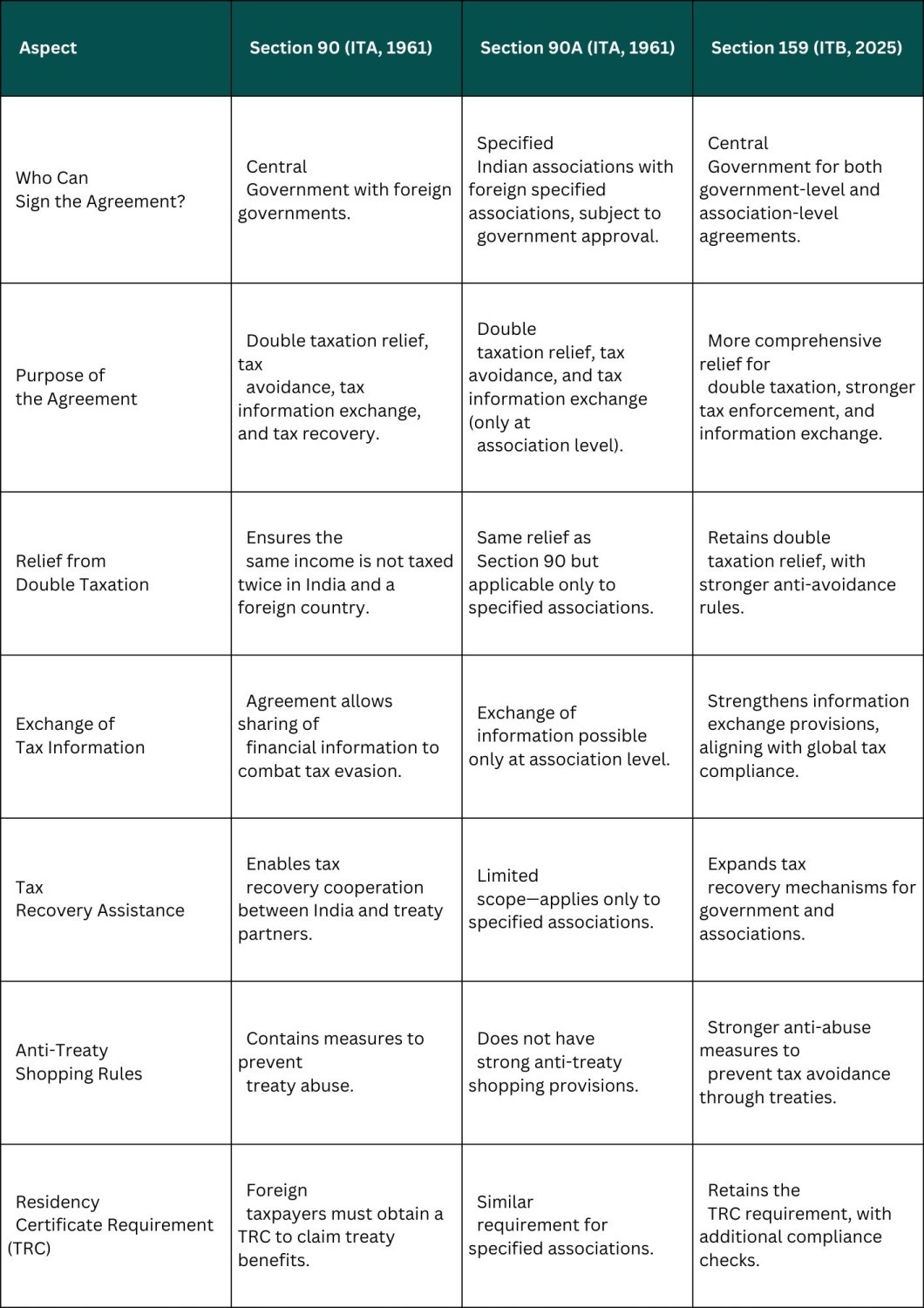
The table below provides a structured comparison of these three sections:
Comparison Table
Final Thoughts & Key Takeaways
1. Section 159 Simplifies Taxation Laws: By merging Section 90 and 90A, Section 159 ensures a single, unified approach to double taxation relief.
2. Stronger Measures Against Tax Abuse: Taxpayers will still benefit from DTAAs, but anti-abuse provisions will prevent misuse through treaty shopping.
3. Global Alignment: The revised framework ensures better compliance with OECD guidelines, making India’s tax system more robust and transparent.
4. Continued Flexibility for Taxpayers: Taxpayers can still choose the more beneficial provision between the ITA and the DTAA.
Conclusion
Section 159 under the Income Tax Bill, 2025, is a progressive reform that simplifies taxation, prevents tax abuse, and ensures stronger international tax cooperation. For businesses and individuals engaged in cross-border transactions, these changes bring greater clarity, efficiency, and fairness in taxation.